Let the phone choose the language
Taking MIZE to Japanese and German: follow the phone's language by default, keep a picker close by, and check each language where people will read it.
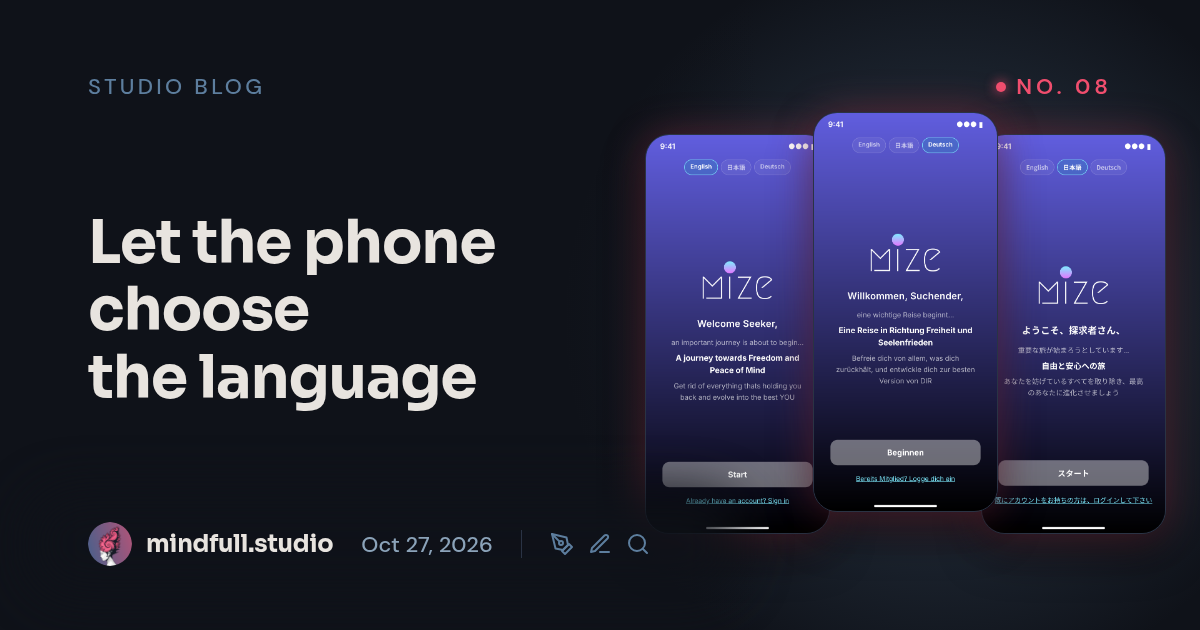
Let the phone choose the language
MIZE is going to speak Japanese and German.
I'll be honest about my starting point. Translation always felt like something you do once the "real" product is finished. A list of strings, sent off, pasted back in. Today changed my mind a little, because most of the decisions turned out to be design decisions, not translation ones.
I woke up one morning with the feeling that this app needed Japanese. Japan already has a deep culture of minimalism, and I think people there would appreciate what MIZE is trying to do more than anyone.
The phone already knows
The first question was simple. When someone opens MIZE, which language should they see?
Our answer: whatever their phone is set to. They already made that choice once, in their system settings. Asking them again on the very first screen is a small tax, and it's a tax on the people we're trying hardest to welcome.
So MIZE follows the phone's language by default.
But don't trap anyone
Defaults are guesses, and guesses are sometimes wrong. Plenty of people run their phone in one language and would rather read an app in another. Some share a device. Some are learning.
So there's a language picker in two places. One sits on the first onboarding screen, so nobody has to get through a whole setup in a language they didn't want. The other lives in Settings, for later, when someone changes their mind.
That pairing feels right to me. A quiet default, and a door that's easy to find.
Read it where it lives
The part I care about most is how we check the words.
German gets a review sheet, so every line can be read and questioned side by side with the original. That's ready for me now.
Japanese gets checked on a live build, on a real phone, in the real screens. A spreadsheet can tell you a sentence is correct. It can't tell you whether it fits the button, or how it sits next to everything else on screen. For a script that looks and wraps so differently from English, I'd rather see it in place than trust a table.
Different languages, different ways of checking. I don't think there's one right method for both.
Where this falls short
A translated app isn't a local one. Words are the visible part. Tone, examples, what feels calm versus what feels cold... those don't come through a string file, and I won't pretend we've solved that. This is a first step, and it will need people who live in those languages to tell us where it reads wrong.
If you speak Japanese and want to help, I'd love you to test MIZE and proofread the Japanese. Reply to this post on X or get in touch through mindfull.studio. Tell me where it reads wrong, feels cold, or doesn't fit. You'll be shaping how MIZE sounds in Japanese.
Respect the choice they already made
The best localization decision we made today wasn't about words at all. It was trusting the setting people chose before they ever met us.
More about MIZE at mindfull.studio.